Church Cooperative Platform Background | All-in-One Church
ALL-IN-ONE CHURCH
OPEN MOBILE COOPERATIVE CHURCH PLATFORM
PLATFORM BACKGROUND · STUDIO WEB EDITION

The more connected the world becomes,
the church needs fewer scattered channels and a clearer path to relationship.

The source material frames information overload, dependence on major platforms, crowded search environments, limitations of online worship, smartphone addiction, and next-generation identity challenges as reasons for a cooperative church platform. This edition converts the image-based source into a readable, searchable, mobile-first website.

CONNECTED WORLD
Global network visual used on the platform background source page
Open Mobile Cooperative Church PlatformA digital foundation that combines church-owned identity with open collaboration.
OWNED + OPEN

The problem is not that the internet became too large. The church's path became harder to see.

The source argues that an online presence alone is not enough. Churches need both an independent digital channel and a cooperative network to build lasting relationships with the next generation.

A church website once served as a sufficient information hub. Today people move continuously across search, social media, video, apps, games, and online communities. The source notes that during and after COVID, churches adopted online worship and video channels, yet members also consumed unrelated content on the same platforms. The resulting need is twofold: a church-owned digital home that preserves identity and an open cooperative network that connects churches, educators, parents, and ministry resources.

Rented channels are not enough

Major platforms expand reach, but they do not give a church control over the whole relationship journey. A church-owned digital home remains important.

More information requires better wayfinding

As search and recommendation feeds become crowded, users need clearer pathways toward worship, Bible learning, mission, and community.

Independence and cooperation can coexist

Each church can preserve its identity and content while sharing selected resources, projects, and discovery pathways through a cooperative network.

Four digital tensions highlighted by the source material

Rather than inventing performance numbers, this section summarizes four recurring themes in the original slides.

OWN
Church-owned channel
A stable digital home beyond platform dependence
OPEN
Two-way cooperation
From one-way publishing to participatory networks
FIND
Search and discovery
Clear pathways through information overload
NEXT
Next generation
Education and community in a smartphone-first era

From a one-way channel to a relationship platform

The source's central transition is not simply more streaming. It is an open, bidirectional, community-oriented digital structure.

CHANNEL ONLY
Worship videos and notices are published, but users can quickly move to unrelated content on the same platform.
Website, social media, community boards, and mobile channels become fragmented.
Faith content depends heavily on search rankings and recommendation algorithms for visibility.
Church-to-church cooperation must be rebuilt for each new event.
VS
COOPERATIVE PLATFORM
A church-owned page becomes the stable hub for worship, learning, care, and group participation.
Church leaders, parents, teachers, and ministries can cooperate around shared themes.
Structured content is designed to improve ongoing discovery through search and sharing.
Resources from one church can be connected to others without erasing local identity.

Four design principles for an open mobile cooperative church platform

The source mentions UCC, Web 3.0, search engines, apps, SNS, and bidirectional networks. Here those ideas are translated into a simpler user-centered structure.

01

Owned Digital Home

Use a church-controlled page as the stable home for worship, learning, community, and mission resources.

HomepageArchive
02

Bidirectional Network

Move beyond administrator-to-audience publishing toward questions, groups, participation, education, and collaboration.

UCCCommunity
03

Searchable Faith Content

Organize content by topic, audience, language, and purpose so useful material can be found again instead of disappearing in a feed.

SearchDiscovery
04

Mobile First Connection

Treat the smartphone not only as a risk but as an entry point to Bible learning, prayer, creative participation, and community.

APPSNSMobile

Move from simply blocking risks to building a community with the next generation

The source highlights social media, gaming, harmful content, smartphone addiction, youth risk behavior, misleading religious information, language and identity gaps, and declining youth ministry.

1. Smartphone, SNS, and gaming dependence

Rather than treating the device itself as the enemy, create Bible education and community experiences that can compete for attention in the same digital environment.

  • Short, clear Bible learning content
  • Youth participation in content creation
  • Clear pathways from online content to real gatherings

2. Youth risk behavior

For sensitive issues such as gambling and sexual harm, the platform can connect church workers, parents, teachers, and support resources rather than relying on warnings alone.

  • Parent-teacher-ministry collaboration
  • Prevention education and help pathways
  • Age-appropriate group learning

3. Crowded and misleading faith information

The source expresses concern about rapid spread of misleading or heretical content through SNS and UCC. The practical response is to improve discovery of trustworthy resources.

  • Shared recommended content
  • Topic-based search
  • Local church link networks

4. Generational, language, and identity gaps

In immigrant and multicultural contexts, parents and younger generations may use different languages and cultural references. A bilingual platform can become a bridge for ongoing discipleship.

  • Bilingual Bible study
  • Age-specific explanations
  • Faith identity connected with local culture

5. Declining youth ministry

The source points to the need for prayer communities in the face of cultural pressure and weakening youth ministry. The platform should organize prayer and care, not replace them.

  • Prayer requests and answered-prayer sharing
  • Intergenerational mentoring
  • Regional joint-prayer projects

6. Fragmented church resources

No single church needs to own every expert, lesson, or media resource. A cooperative network can make complementary strengths reusable across churches.

  • Shared lessons, lectures, and events
  • Ministry and teacher networks
  • Local church identity preserved

Show a simple participation path, not a wall of technology names

Homepage, UCC, Web 3.0, search, apps, and SNS become easier to understand when arranged as one user journey.

ALL-IN-ONE CHURCHopen cooperative platform

Church Digital Flow

OWN
HOME
OPEN
NETWORK

One path, many touchpoints

WEB
APP
SNS
GROUP
1. Independent website
The stable home where the church owns and organizes its information.
2. UCC and video
Sermons, testimonies, education, and next-generation content become participatory media.
3. Search and topic structure
Scattered content becomes reusable by topic, audience, and purpose.
4. App and mobile touchpoints
Participation begins where members and the next generation already spend time.
5. Social discovery
Social media becomes a discovery channel that can lead people back to church-owned content.
6. Cooperative church network
Churches, parents, teachers, and ministries connect around shared themes and projects.

Translated into today's language, the source suggests ten strategic shifts

These are modern applications derived from the source's concerns, not literal translations of the original slide text.

01

Fewer channels, one digital home

Use YouTube, social media, and messaging, but let the stable relationship return to a church-owned platform.

02

Belonging over broadcasting

Views alone do not create community. Questions, groups, follow-up, and participation must return.

03

Wayfinding over search competition

Instead of competing with everything online, organize trusted church resources so users can find a clear next step.

04

Redirect the smartphone instead of merely removing it

Use the device for Bible learning, prayer, service, creativity, and real community participation.

05

Make youth co-creators, not only protected users

Invite the next generation to help create testimony, media, and learning projects.

06

No church has to do everything alone

A cooperative network allows different church strengths to complement one another.

07

Bilingual design is a generational bridge

Parents and younger generations can engage the same Scripture and theme in the language each understands best.

08

Good content disappears without structure

Topic, audience, language, and related resources turn one-time content into a lasting learning asset.

09

The platform is ministry infrastructure, not the ministry itself

The goal is not an app. The goal is an uninterrupted path among worship, learning, mission, and care.

10

Healthy online connection ends in real relationship

A digital platform succeeds when it leads to worship, small groups, support, service, and mission participation.

The original visual materials are preserved below

The original `platformbr` page presents its main content as image slides. This web edition preserves those images while converting their key ideas into searchable HTML text for better mobile readability.

Original slide introducing the digital world and the background of a church cooperative platform

Digital world and platform background

Introduces the need for a church-owned digital foundation in an environment of massive information and connectivity.

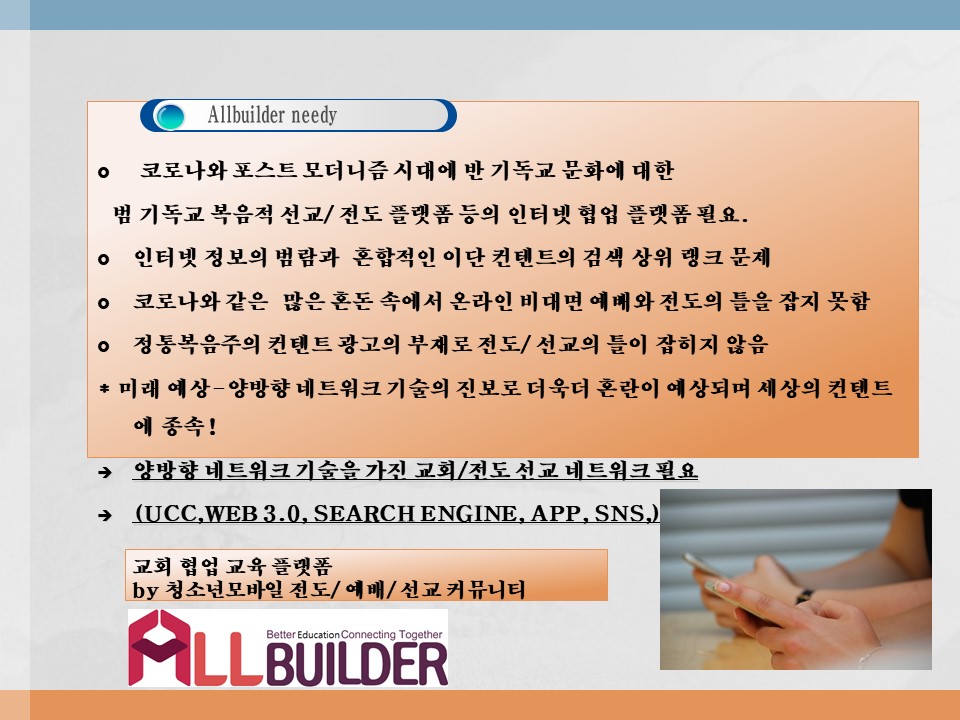
Original slide about social media online worship and the need for an independent church platform

SNS, online worship, and owned channels

Frames next-generation communication, platform dependence, and content consumption as background issues.

Original slide listing reasons for an internet cooperative church and mission platform

Why a cooperative platform

Discusses search clutter, online worship, limits of traditional promotion, and the need for bidirectional networks.

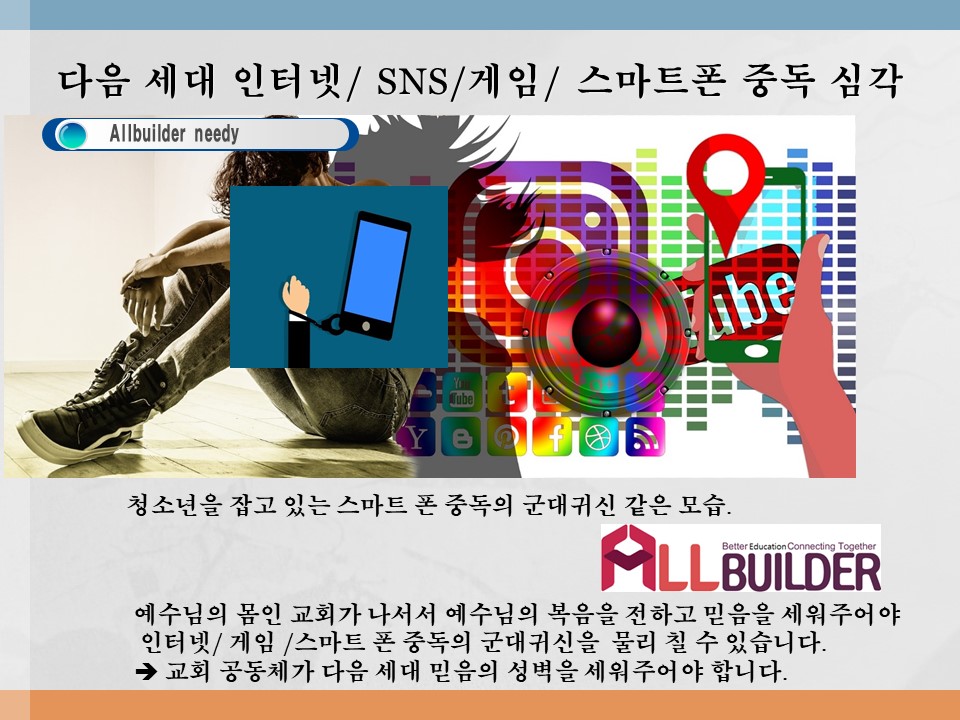
Original slide on next generation internet social media gaming and smartphone addiction

Next-generation smartphone challenges

Calls for the church community to provide a stronger faith-forming environment for young people.

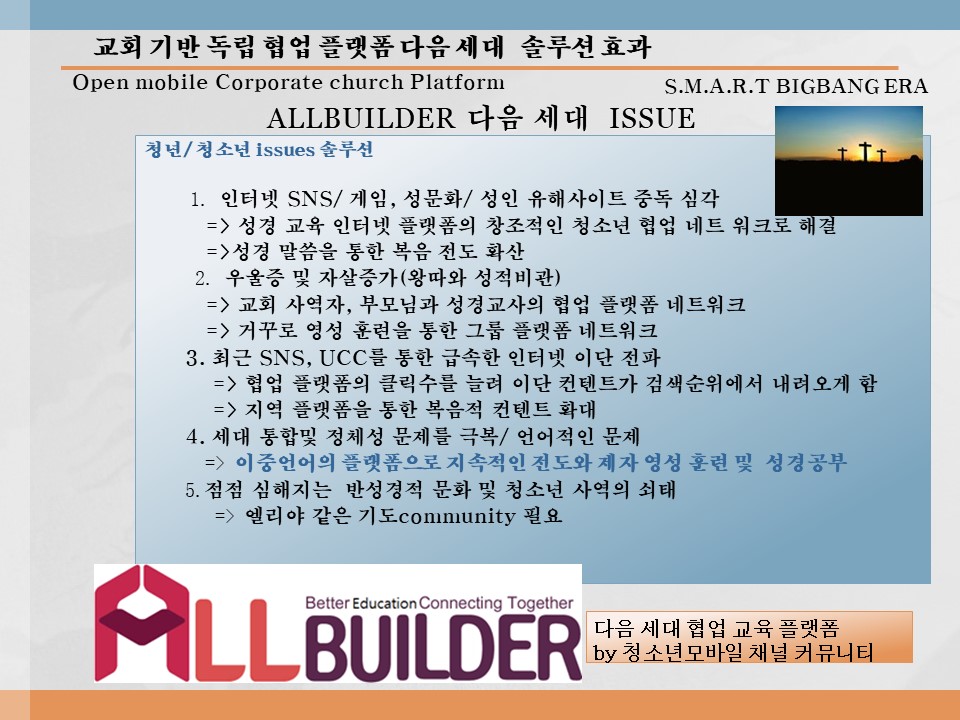
Original slide summarizing next generation issues and cooperative church platform solutions

Next-generation issues and solutions

Presents cooperative responses to addiction, risk behavior, misleading religious content, language and identity issues, and declining youth ministry.

Original global network background image

A connected world

The network image symbolizes the background thesis: technology should ultimately connect people and communities.

Start with a small successful connection, not a giant platform

The source explains the rationale and direction but does not specify a rollout schedule. The following sequence is a studio-style implementation proposal for turning the source ideas into a real web project.

STEP 1

Organize the digital home

  • Define the church and ministry information architecture
  • Classify worship, education, youth, and mission content
  • Design clear mobile CTAs
STEP 2

Connect the cooperative network

  • Connect parent, teacher, youth, and ministry groups
  • Share learning materials, events, and media
  • Create cross-church links and joint projects
STEP 3

Improve search, language, and distribution

  • Improve topic search and content archives
  • Expand bilingual and multilingual content
  • Measure how social discovery returns users to the owned platform
Measure

What should be measured?

Look beyond views to search entry, group participation, learning registrations, worship or event connections, and repeat visits.

Protect

What should be protected?

Define minimal personal-data collection, church identity, youth safety, content sources, and operating responsibility from the beginning.

Expand

When should it expand?

Validate the workflow in one group or church before extending it to a wider cooperative church network.

Before building a platform, choose one ministry problem

Choose one urgent need such as next-generation education, a joint church event, bilingual Bible study, content search, or regional church collaboration. That gives the first version a clear purpose.

Four questions for the first consultation

1. What ministry problem is most urgent?
2. Who are the primary users and age groups?
3. Which website, social, and video channels are already used?
4. Where is cooperation with churches, parents, or teachers needed?

info@smartcubic.com
QR code for the original All-in-One Church platform background page
Open the original platform backgroundScan the QR code to open the source `platformbr` page.

Typical response within 24 hours · Initial consultation without contract

Own the home. Open the network.

The best digital strategy for the next generation is not leaving the internet.
It is building a better path through it.

Bring the church-owned website, searchable faith content, bidirectional community, and church cooperation into one clear flow. The goal is not more technology. The goal is better connection.

ALL-IN-ONE